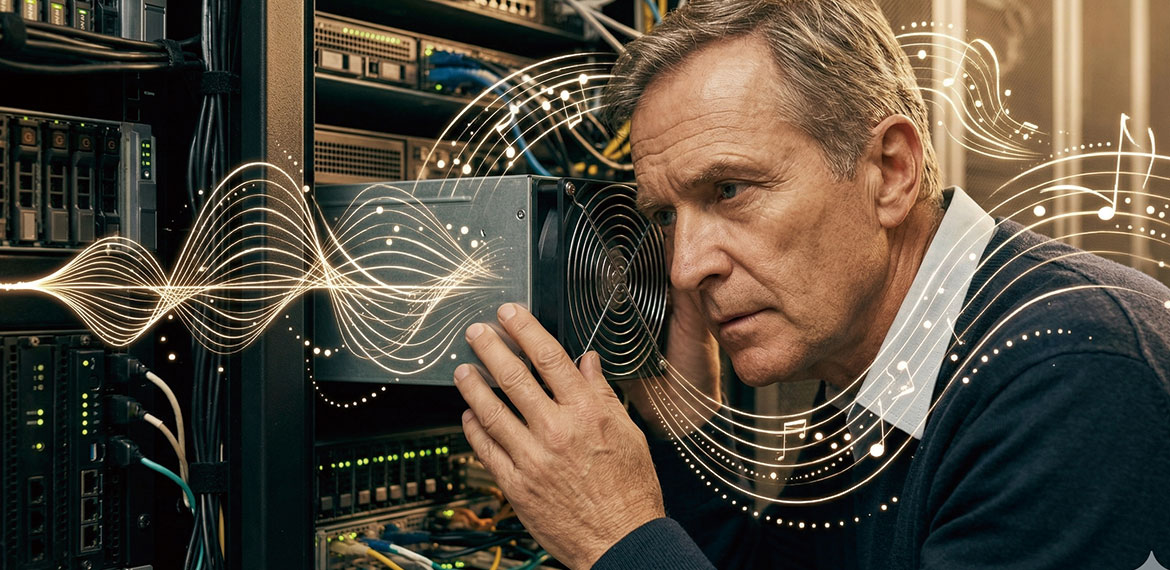
The "Symphony" of the Data Center: How to Detect Potential Faults Through the Five Senses
 Infinity High-Performance Computing
In IHPC's operation and maintenance philosophy, data centers (IDCs) are no longer seen as noisy industrial sites, but rather as a meticulously operated "symphony". The role of operation and maintenance personnel is like that of a conductor; they must be able to identify any discordant notes (potential faults) in this symphony through "five senses inspection." The following is a detailed analysis and operational guide for using five senses to detect potential IDC faults:
I.Auditory: Listening to variations beyond the "fundamental frequency" In IHPC's operation and maintenance philosophy, technicians are trained to memorize the "rhythmic baseline" of the server room. Any sound that deviates from this baseline is a prelude to a malfunction. •The "Stand Still Protocol": The states that when an alarm sounds or enters the server room, the first action is not to run, but to "stand still for 5 seconds." This time is used to filter background white noise, allowing the auditory system to adapt to the environment and thus pinpoint the physical source of the abnormal noise. •Key Abnormal Sound Identification Table: oHigh-pitched whining/grinding: This is a typical characteristic of bearing wear. Initially, it is ultrasonic (inaudible to the human ear and requires instruments). When the sound of metal friction can be heard by the human ear, it indicates that the bearing is severely damaged. oRocks in a blender: This is the characteristic sound of pump cavitation. It indicates that the pump is drawing in air or the suction head pressure is insufficient, causing bubbles to burst inside the impeller and rapidly erode the impeller surface. oFrying/Hissing/Crackling: This is the sound of arcing or corona discharge in high-voltage switchgear, usually accompanied by severe electrical hazards. oSquealing: A sign that the fan belt is slipping, misaligned, or insufficiently lubricated. oKnocking/Rattling: The structure is loose, such as loose screws on the motor base or broken internal parts. II. Olfactory: Detecting overheated chemical reactions. The earliest warning system for chemical degradation or electrical insulation failure, even detecting anomalies earlier than smoke detectors. •Rotten Eggs: oDiagnosis: The lead-acid battery (UPS battery) is experiencing thermal runaway or severe overcharging, releasing hydrogen sulfide gas. oDanger: Highly toxic and corrosive; evacuation and emergency notification must be initiated immediately. •A fishy or urine-like odor: oDiagnosis: The electrical plastic components (such as bakelite) in the circuit breaker or socket are severely overheated. This is a typical precursor to an electrical fire. •Metallic ozone scent: oDiagnosis: The smell of air is similar to that after a lightning strike, confirming the presence of an active electric arc or corona discharge in the electrical room. •Burning rubber smell: oDiagnosis: Overheating due to belt friction, melting of motor insulation, or circuit overload. III. Tactile sensation: sensing airflow and temperature field Safety Warning: Tactile inspections must strictly adhere to LOTO (Lock-on Tag) and non-contact safety protocols. •Airflow Short-circuiting Detection: Technicians use their skin to sense the airflow direction in the hot and cold aisles. If hot air is felt flowing back into the server's air intake (cold aisle), it indicates an airflow short-circuiting has occurred, and cooling efficiency is decreasing. •Abnormal vibration: Feel for any extra vibrations by touching the casing (non-rotating parts). This usually indicates rotor imbalance or misalignment. •Temperature gradients: If an abnormal temperature rise is felt at the battery terminals or cable joints (usually requiring confirmation with a thermal imaging camera), it indicates that the contact resistance is too high and there is a risk of loosening. IV. Visual: Seeing the variations in physics and chemistry Visual inspection is not just about looking at instruments, but also about observing subtle changes in physical appearance. •Bluing: The appearance of blue or iridescent spots on a metal surface is evidence of extreme overheating. •Foaming or Darkened Oil: If the lubricating oil in the pump or gearbox foams, it means that air has entered or lubrication has failed; if it turns black, it means that the oil has deteriorated or that the metal is worn. •Leak Trails: Look for coolant, oil stains, or water marks, which is especially crucial in 2026 when liquid cooling will become standard. •Abnormal battery appearance: Observe whether the battery is bulging (bulged tank) or has torn separators (separator tears), which are signs of internal short circuit. V. Cognitive Integration: The Moment of Entering Meditation The fifth sense is not a single sense, but rather the brain's comprehensive ability to process the above information, which is intuition. •Moment of Settling: At 5:30 PM daily, technicians need to step back from operations and engage in "cognitive integration." This is a process of logically organizing the sounds heard, smells smelled, and data seen that day, transforming fragmented sensory information into a "system health image." •Pattern Recognition: Senior technicians (Guardians) can hear the noise in the server room as a "symphony." When the frequency of a certain instrument deviates slightly (is out of tune), even if the dashboard light is not yet red, they can intuitively tell "something is wrong." 💡Digital Transformation Summary: Although "five senses inspection" relies on human experience, the future strategy is to digitize this tacit knowledge. 1.Acoustic AI: Using a contact microphone and FFT/MFCC algorithms, AI learns to detect the "high-frequency squeal" of bearings. 2.Augmented Reality (AR): Using AR glasses, the internal temperature of the equipment (X-ray view) is directly superimposed on the technician's eyes, realizing "super-sensory" inspection. This evolution from "human senses" to "digital sensing" is precisely the core strategy of IHPC in building a "digital operating room that never closes."We offer a variety of IDC services to help you succeed.